
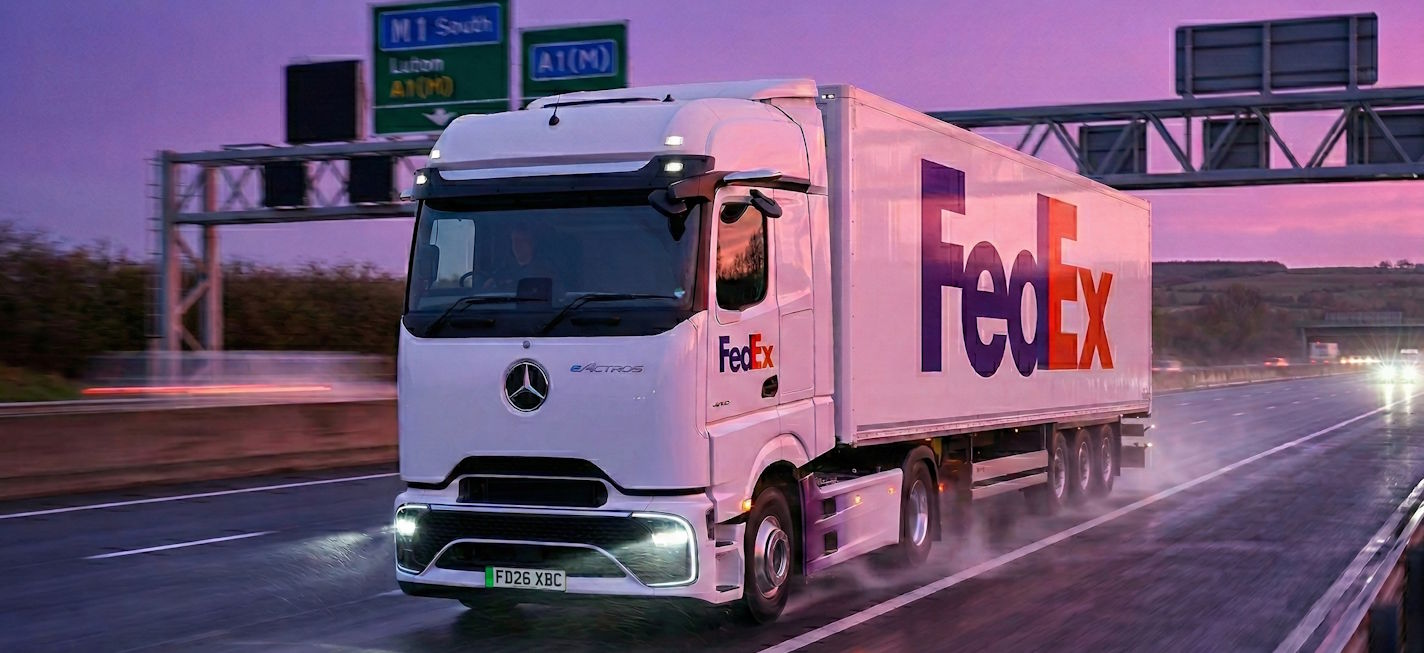
A 6-Week PoC with FedEx European Linehaul
Executive Summary
Decision Intelligence moves an organisation beyond the fixed-plan trap toward proactive, automated resilience in route optimisation. By evaluating the strategic trade-offs between explainable Stochastic Optimisation and scalable Reinforcement Learning, we proved that move-level agility is the key to maintaining flow in a high-uncertainty environment.
Key Takeaways:
- Beyond Rigid Scheduling: Shifting from historical templates to dynamic, operational-time decision-making to maximise capacity utilisation.
- The Technical Showdown: Comparing the audit trails of Stochastic Programming against the autonomous adaptability of Reinforcement Learning.
- Predictive Simulation: Utilising a road-based “digital sandbox” to test courses of action and mitigate risks before committing resources.
- Tangible ROI: Delivering financial returns by improving linehaul utilisation and significantly reducing the need for costly ad-hoc transport.
The Challenge: The Friction of Fixed Planning
In the high-stakes corridors of European logistics, fixed plans are often the first casualty of reality. For an Operations Director managing a distribution network across the UK and EU, the daily friction is visceral. You are constantly forced to ask: “Should I delay this trailer, so it leaves full, or stick to the schedule? Do I need to commission an expensive ad-hoc truck to cover this surge, or will the bottleneck clear itself?”
When package volumes fluctuate unpredictably at major hubs, static schedules become more than just an inconvenience—they become a drain on margins and a threat to service levels. At Decision Lab, we operate under a foundational truth: the success of an organisation is nothing but the sum of all its decisions. To help global leaders move beyond the fixed-plans trap, we conducted a six-week Proof of Concept (PoC) with FedEx. This project tackled real-world complexity head-on, proving that Decision Intelligence is the key to transitioning from reactive firefighting to proactive, automated resilience.
Static Schedules are the Enemy of Efficiency
The core challenge identified within FedEx’s European network was the inherent limitation of pre-defined linehaul schedules. These schedules were designed for averages, whereas logistics are often defined by exceptions. When incoming and outgoing package volumes at European hubs diverged from the forecast, rigid plans could not adapt.
A dynamic approach, powered by operational-time decision-making, is the only way to maintain flow in a volatile environment. By rerouting assets and scheduling departures based on real-time parcel traffic rather than historical templates, an organisation can achieve step-changing improvements in capacity utilisation.
Our expertise in AI, ML, simulation, and mathematical optimisation helps organisations cut through complexities in strategic, tactical and operational processes.
The Solution: Bridging the Gap with Decision Intelligence
The choice between technical approaches is rarely straightforward; in this case it was a strategic balancing act between Explainability and Scalability. During our PoC, we evaluated two competing methodologies: explainable Stochastic Programming and scalable Reinforcement Learning (RL).
| Feature | Stochastic Programming | Reinforcement Learning (RL) |
|---|---|---|
| Primary Strength | Fast solving speed; mathematically explainable and provable. | Reacts to high uncertainty using World Models and Graph Neural Networks. |
| Logic Basis | Locates the best strategy to optimise expected outcomes over uncertainty. | Uses a dynamics model to predict the optimum next action. |
| Adaptability | Multi-objective handling: Uniquely suited for balancing cost vs. customer service levels. | Observation-size invariant: Handles environments with variable data lengths and network nodes. |
| Strategic Risk | Consulting intensive: Very sensitive to human-built heuristics, which are expensive and time-consuming to develop. | Compute intensive: Requires significant hardware resources for training the World Model. |
While Stochastic Programming offers a clear audit trail for every decision, RL provides the adaptability required for massive, interconnected networks. The right choice depends on whether your organisation prioritises a provably optimal solution or a highly performant best-effort that can autonomously learn the shifting dynamics of global markets.
Don’t Just Predict—Simulate the Impact
One of the most powerful tools developed for FedEx was a road-based, hub-to-hub package movement simulator. This provides a digital sandbox where controllers can explore alternative COAs (Courses of Action) before committing resources.
Our completely data-driven deployment method allows us to build these simulations without the months of manual coding traditionally required. By accessing relevant operational and transport data directly, we can simulate supply chain environments to predict the ripple effects of a delay or reroute.
This tool predicts the impact of different actions, helping to mitigate risks and optimise routes.
Data Maturity is the Ultimate Competitive Moat
For large-scale firms with a £200M+ turnover, the transactional backbone—usually an ERP or MRP system like SAP or Oracle—is necessary but insufficient. To achieve true antifragility, you must layer Decision Intelligence over these systems.
Antifragility is the ability to not just survive volatility, but to actually improve because of it. By utilising a World Model within an RL framework, the system treats every fluctuation in package volume as a learning opportunity, refining its dynamics model to better anticipate future shocks. This requires three layers of data maturity:
- Strategic Level: Long-term high-level routes, fleet capacity, and cost-per-mile data.
- Operational Level: Real-time visibility into items currently loaded or waiting at the depot.
- Historical Level: Deep archives of how volumes fluctuated in similar time slots in the past.
The Result: Antifragility and Bottom-Line Returns
In the C-suite, the value of AI is measured by the bottom line. The FedEx project was not an academic exercise; it was focused on delivering the financial returns demanded by an industry with tight margins. The PoC demonstrated that an autonomous planning agent directly impacts:
- Improved Linehaul Utilisation: Driving higher Overall Equipment Effectiveness (OEE) across the fleet.
- Reduced Rescheduling: Eliminating the administrative friction and cost of mid-stream plan changes.
- Minimised Ad-hoc Linehauls: Directly de-risking Operational Expenditure (OPEX) and informing more accurate Capital Expenditure (CAPEX) by reducing the need for emergency transport.
Conclusion: Toward the Global Digital Twin
The ultimate evolution of this journey is an advanced road-based package movement digital twin. By connecting multiple hubs in real-time, organisations can create a living model of their entire network that learns, adapts, and optimises itself.
What is the sum of your organisation’s decisions? How many of your current logistics choices are being left to a fixed plan that no longer fits your reality? In a world of increasing volatility, the goal is no longer just to have a plan—it is to have a system that provides decision clarity and reliable value.
Transform your logistics operations today. Reach out directly via out contact page, or connect with us on LinkedIn to start a conversation about de-risking your future.