Solving the Interdependent Challenges of Packing Fitness and Delivery Distance
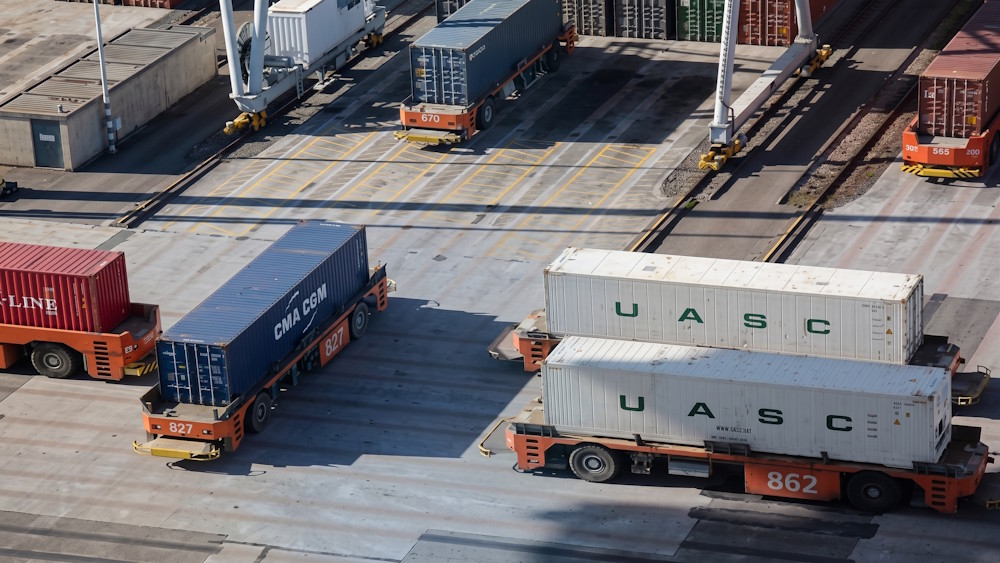
In global distribution, operational efficiency is a balancing act between conflicting physical realities. To maximise margins, supply chain leaders are constantly caught between two critical metrics: packing fitness (how densely items are secured within a vehicle) and delivery distance (the total mileage of the transportation route).
For any commercial fleet, the core objective is simple: deliver inventory from a central hub to multiple destinations at the absolute lowest total cost. Yet, when executed on an enterprise scale, material costs (pallets, vehicle overheads) and transport costs (fuel, driver hours) frequently pull operations in opposite directions.
To achieve true capital efficiency, decision-makers can no longer afford to evaluate packing and routing in isolation. They must be solved simultaneously.
The Costly Reality of Fragmented Models
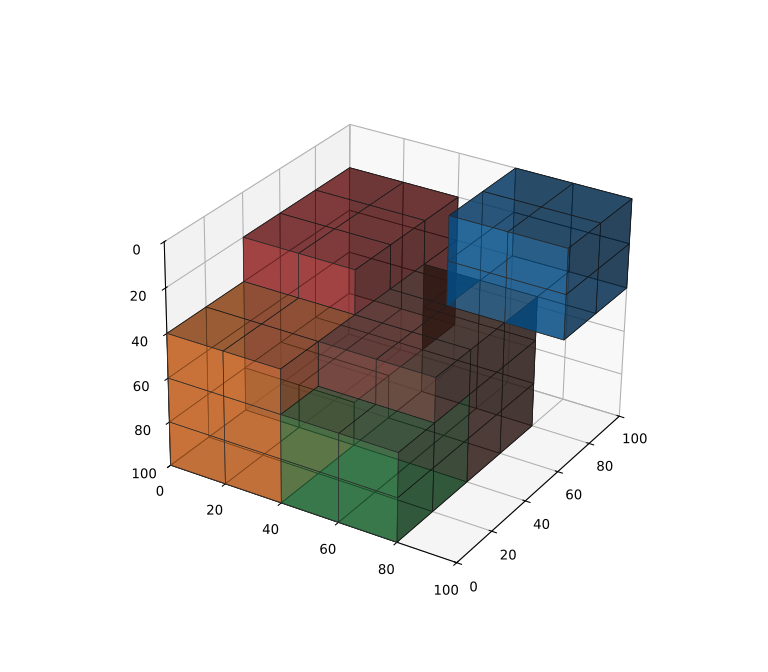
Traditionally, logistics architecture has relied on the Separated Packing and Routing (SPR) model. This legacy approach treats the Bin Packing Problem (BPP) and the Vehicle Routing Problem (VRP) as two entirely independent workflows managed by separate teams.
While the SPR model offers administrative simplicity, it introduces two critical operational flaws:
- Conflicting Corporate Objectives: Packing teams focus entirely on minimising fixed asset and pallet usage, while dispatch teams focus solely on reducing mileage. Without a unified framework, these goals directly undermine each other.
- The 20% Cost Penalty: Because packing configurations are finalised before routing algorithms begin, vital destination and drop-off sequence data are completely excluded from the initial loading phase. This structural blind spot creates systemic delivery bottlenecks and highly sub-optimal routes.
The Computational Bottleneck
The obvious alternative is an integrated model powered by Mixed Integer Programming (MIP). When paired with advanced mathematical solvers like Gurobi, MIP models can guarantee a mathematically flawless, optimal solution.
However, exact mathematical modeling suffers from exponential computational scaling. For an enterprise fleet managing 1,000 boxes across 100 destinations, calculating a perfect MIP solution could literally take years of computing time. In live logistics environments where windows are tight, this approach is commercially unfeasible.
Introducing LOGOS+: Next-Generation Hyper-Heuristics
To bridge the gap between mathematical idealism and real-world operational velocity, Decision Lab developed LOGOS+ (Logistics Optimisation System — Two-Level Capacitated Vehicle Routing Problem, or LOGOS-2S-CVRP).
LOGOS+ is a proprietary hyper-heuristic framework that bypasses exponential computing delays. By combining two distinct algorithmic classes, it delivers near-optimal operational plans in seconds.
1. Constructive Heuristics
This layer builds a highly viable, baseline operational solution from scratch using two distinct, configurable strategies:
- Volume-Driven (VD) Heuristics: Prioritises the minimisation of material and pallet costs. Items are systematically sorted and packed into vehicles based on customisable, high-scoring geometric constraints.
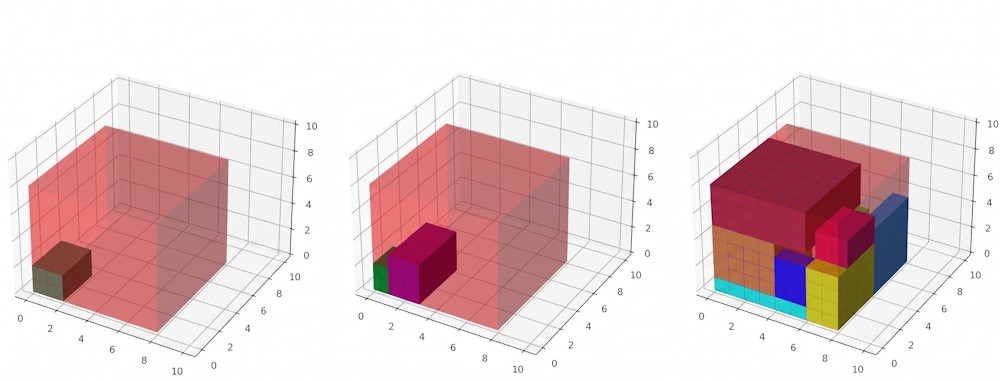
- Destination-Driven (DD) Heuristics: Prioritises transportation efficiency. The engine automatically clusters items by geographic proximity or pre-loads containers to perfectly align with the intended multi-drop sequence.
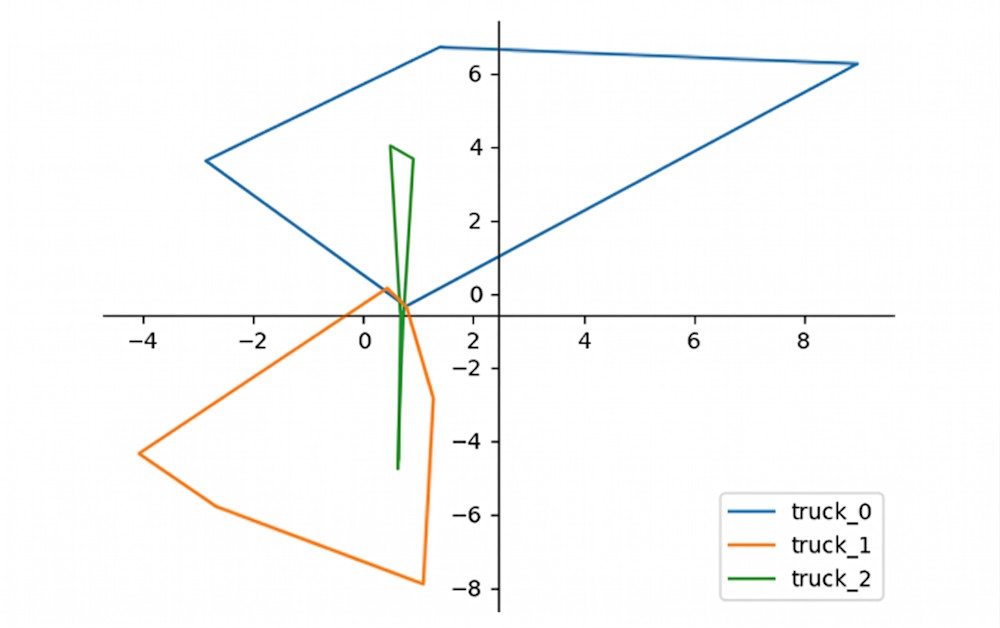
2. Perturbative Heuristics
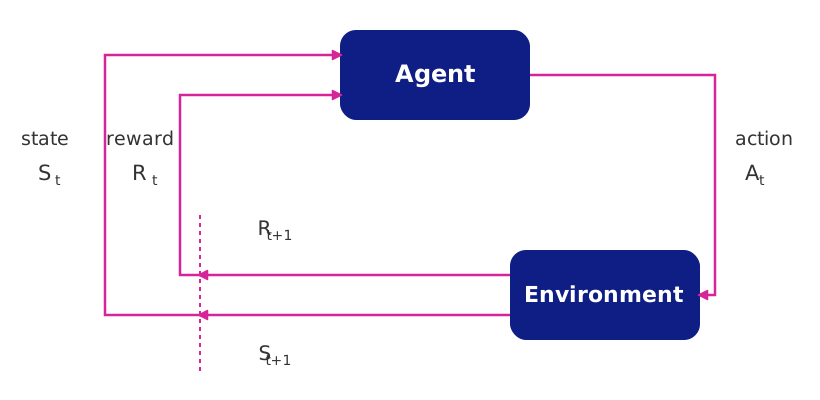
Once the initial solution is constructed, LOGOS+ deploys advanced local search and hill-climbing algorithms to eliminate hidden inefficiencies. The engine continuously optimises the fleet layout via four core operators:
Packing Swap: Exchanging assets between two vehicles to achieve a superior volumetric fit.
Packing Insert: Shifting an individual item to an alternative vehicle to maximise space utilisation.
Degrading: Completely unloading a under-utilised vehicle and resetting its contents across the remaining fleet.
Destination Swap: Altering the drop-off sequence within a single vehicle’s manifest to uncover a shorter, faster transit path.
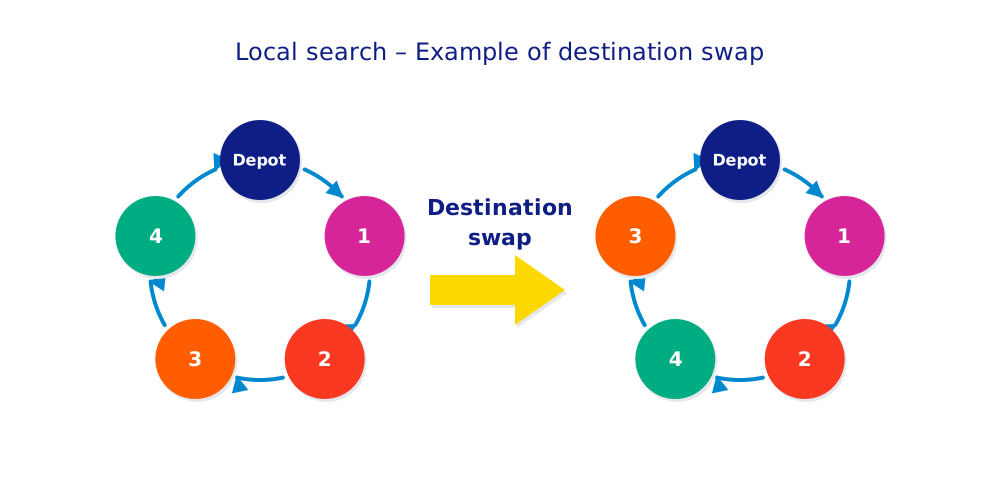
The system iterates automatically, accepting a new layout only if it actively reduces total operational expenditure, until a refined local optimum is achieved.
Proven Performance and Speed
Through rigorous benchmarking against randomised enterprise datasets scaling up to 80 variables and 50 destinations, LOGOS+ demonstrated a massive leap forward in computational and financial performance.
| Optimisation Method | Solution Quality | Computation Time | Operational Viability |
| Separated Packing & Routing (SPR) | Poor (Up to a 20% cost penalty vs integrated models) | Very Fast (Seconds) | High administrative ease, but poor financial efficiency. |
| Mixed Integer Programming (MIP) | Perfect (100% mathematically optimal) | Extremely Slow (30+ mins for just 10 boxes) | Commercially unfeasible for live, large-scale operations. |
| LOGOS+ (Hyper-Heuristic) | Excellent (Averages within 10% of true mathematical optimum) | Instantaneous (Processes 1,000 boxes across 100 drops in 6.52 seconds) | Ideal for real-time, large-scale enterprise logistics. |
Strategic Business Impact
LOGOS+ represents a significant paradigm shift for enterprise supply chains. Rather than breaking logistics challenges apart (packing individual pallets, loading vehicles, and planning routes in silos) our engine processes them within a single, unified pipeline.
By eliminating the traditional 20% cost penalty associated with fragmented planning, LOGOS+ allows organisations to tailor their optimisation core to match specific corporate KPIs:
- Decarbonisation & Sustainability: Configure the system to explicitly minimise total CO2 emissions, automatically influencing optimal vehicle selection and routing configurations.
- Bottom-Line Maximisation: Dynamically balance fuel consumption variables against fluctuating driver labor rates, clean-air zone fees, and service level agreements (SLAs).
What’s Next: The AI Frontier
While we are actively expanding our suite of heuristics, our next frontier is total intelligent automation. Decision Lab is currently developing an Artificial Neural Network (ANN) layer designed for automatic algorithm selection. Once deployed, this AI capability will instantly evaluate incoming logistics profiles and automatically select the absolute best heuristic combination for that specific dataset, unlocking true hyper-optimality without human intervention.
LOGOS+ is architected to serve as the high-performance optimization engine powering modern supply chain and enterprise resource planning software.
To learn how to integrate this capability into your logistics ecosystem, contact us.