
Tag: pharma

  • Navigating the PolyCRISIS: Why Supply Chain Resilience is Dead

    Navigating the PolyCRISIS: Why Supply Chain Resilience is Dead

    …and what Supply Chain leaders must build instead

    The global macroeconomic environment has definitively transitioned from an era of manageable disruptions into one of permanent, systemic volatility. The 2026 closure of the Strait of Hormuz has severed one of the world’s most critical maritime and economic arteries, demonstrating exactly how fragile our interconnected systems have become. Following the blockades, commercial maritime traffic in the region has collapsed by over 90%.

    The war in the Middle East is creating the largest supply disruption in the history of the global oil market.

    The International Energy Agency (report)

    While the immediate reaction framed this purely as an energy shock, supply chain analysts rightly characterise the current operating environment as a ‘PolyCRISIS’. We are witnessing cascading failures across energy, manufacturing, agriculture, and finance.

    At Decision Lab, we recognise that for senior supply chain leaders, the illusion of a stable, predictable global landscape has entirely shattered. The overarching philosophy of the past three decades that was focused on hyper-optimised, just-in-time (JIT) manufacturing is no longer viable. It is time to abandon the pursuit of mere resilience and engineer genuine antifragility.

    The Antifragile Imperative

    Traditional resilience relies on static, defensive buffers: hoarding excess safety stock, contracting redundant suppliers, or building idle capacity. Resilience is designed to absorb a disruption and bounce back to a baseline state. However, these buffers are economically inefficient and inherently fragile when confronted with black-swan geopolitical events that exceed their design parameters.

    A diagram of the Uncertainty Spectrum, showing the progression from a Fragile state (suffers from uncertainty) to a Resilient state (resists uncertainty) to an Antifragile state (gains from uncertainty).

    Antifragility, a concept coined in a book of the same name by risk analyst Nassim Nicholas Taleb, describes systems that do not merely withstand volatility, but actively learn, adapt, and grow stronger as a direct result of it. If fragility implies breaking under stress, antifragility implies thriving because of it.

    Through mathematical optimisation, artificial intelligence, and probabilistic modelling, Decision Lab helps organisations map the full probability density function of all plausible future scenarios, executing a strategic paradigm shift toward antifragility. Here is how we are architecting this transformation across four critical operational vectors.

    1. AI-Driven Energy Orchestration

    The Strait of Hormuz closure has triggered severe spot market volatility in energy. This is particularly damaging in the UK, where energy constitutes one of the largest single operational expenses for the FMCG and Pharmaceutical sectors, with the UK Pharmaceutical sector spending over £1 billion annually.

    To survive, manufacturers must transition into dynamic energy orchestrators. Decision Lab’s EcoSynth architecture provides an AI-powered orchestration engine that constructs a highly detailed mixed-integer linear programming model of a facility.

    • By ingesting historical data, grid pricing, and weather forecasts, the system precisely anticipates the cost and carbon footprint of every kilowatt-hour required.
    • It intelligently identifies non-critical processes and autonomously shifts them to cheaper, low-carbon off-peak windows.
    • Implementations of EcoSynth have demonstrated the ability to deliver a 7% to 12% reduction in total site energy consumption.

    To see this principle applied, explore our work on building an antifragile pharmaceutical production facility and creating an antifragile future for medicines manufacturing.

    2. Probabilistic Supply Chain Digital Twins

    With the Red Sea rendered highly dangerous, global shipping lines are rerouting around the Cape of Good Hope, adding 3,500 to 11,000 nautical miles to Asia-to-Europe voyages. This introduces a paralysing 10 to 15-day delay into global networks.

    Decision Lab addresses this operational blindness through Probabilistic Supply Chain Digital Twins.

    • A Digital Twin is a highly accurate, mathematical replica of an organisation’s entire end-to-end logistics network.
    • The system uses Monte Carlo simulations to inject realistic randomness into the model, generating thousands of potential future states based on variables like port congestion and weather.
    • Instead of waiting for delays to manifest as stockouts, planners can dynamically simulate mitigation strategies, transforming unmanageable chaos into a quantifiable mathematical equation.

    For an in-depth look at how this operates at scale, review our case study on strategic capacity planning for a revolutionary pharmaceutical development, developed in collaboration with AstraZeneca.

    3. Multi-Echelon Inventory Optimisation (MEIO)

    The global supply of Active Pharmaceutical Ingredients (APIs) is dangerously concentrated, with approximately 60% to 70% of global production situated in Asia. When supplier lead times stretch unpredictably, traditional single-echelon inventory models inevitably fail, leading to the massive inventory swings known as the “bullwhip effect”.

    Decision Lab resolves this through Multi-Echelon Inventory Optimisation (MEIO).

    • MEIO simultaneously analyses Asian API suppliers, maritime lanes, European formulation facilities, and distribution centres to evaluate the entire network holistically.
    • The system identifies the precise mathematical optimum for inventory positioning, balancing the high cost of holding working capital against the catastrophic risk of a medical stockout.
    • Documented industry applications of MEIO methodologies have consistently demonstrated structural inventory cost reductions ranging from 10% to 35%.

    Discover more about how we implement this via optimised production and sustainable capacity planning.

    4. Autonomous Execution with Agentic AI

    The friction generated by the Middle East conflict has manifested as severe financial strain, with war-risk premiums and escalating bunker fuel costs adding between £150 and £600 per container. In this volatile environment, human supply chain planners simply cannot move fast enough to secure optimal routing.

    The solution is Agentic AI.

    • Unlike traditional AI designed to passively answer questions, Agentic AI is engineered to take goal-oriented, autonomous action.
    • When the agent detects a massive rate spike or capacity crunch, it evaluates mitigation strategies and can autonomously execute the optimal response—booking freight space and rerouting shipments directly within the enterprise software environment.
    • Agentic frameworks promise to reduce overall logistics costs by up to 15% and optimise inventory levels by 35%.
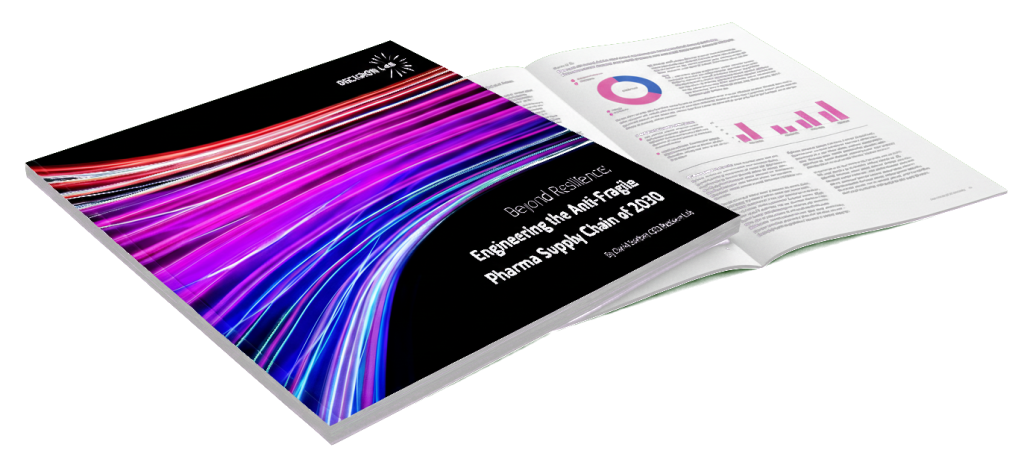
    Moving an organisation along the spectrum from a fragile to an antifragile state requires a new cognitive architecture for decision-making. For a detailed guide on the four pillars of this transformation—from de-risking capital decisions to building a sentient factory—download our complete white paper.

    Securing the Future: Our Commitment to AI-TRiSM

    As we integrate these highly autonomous, self-governing systems into critical supply chains, trust and security are paramount. Decision Lab maintains an unwavering commitment to AI-TRiSM (AI Trust, Risk, and Security Management). We ensure that every algorithm deployed, from our Digital Twins to our Agentic AI frameworks, operates within strictly defined guardrails of “bounded autonomy,” ensuring models are rigorously transparent, compliant, and secure.

    Our advanced tooling is specifically engineered for mid-to-large global manufacturers seeking to dominate complex markets through mathematical superiority. The mandate for the C-suite is clear: do not wait for the next macroeconomic shock to expose the limits of your operational architecture.

    By partnering with Decision Lab to embed predictive foresight and intelligent automation into your value chain, you can secure antifragile pharma production and transform today’s vulnerabilities into tomorrow’s insurmountable competitive advantage.

  • Optimised Production and Sustainable Capacity Planning

    Optimised Production and Sustainable Capacity Planning

    GSK’s Journey to Enhanced Supply Chain Antifragility

    The orange GSK logo, with a flowing, interconnected design that symbolises the link between science, technology, and talent to drive biopharma innovation.

    The Challenge: Navigating Volatility in Pharma & Life Sciences Manufacturing

    Global pharmaceutical manufacturers seek to optimise production and capacity planning. Challenges such as changeover downtime, CAPEX tied up in production lines, and the need to rapidly scale or reconfigure capacity to meet fluctuating demand and forecasts are common. In a sector where agility and resilience are paramount, these pain points directly impact operational efficiency, financial performance, and the ability to achieve critical sustainability goals.

    GSK, a global biopharmaceutical leader with a vast manufacturing footprint, encountered a specific, yet broadly relevant, challenge at its Irvine site. While a clear correlation existed between batch production schedules and energy consumption, the unpredictable nature of machine usage made accurate energy forecasting incredibly difficult. GSK sought greater foresight to understand the true financial and environmental impact of its production planning decisions and to strategically integrate renewable energy sources. This scenario is a microcosm of the larger need for supply chain antifragility in the pharma sector – the ability not just to withstand disruption, but to improve and adapt.

    The Solution: Predictive Analytics & Simulation for Antifragile Operations

    Decision Lab partnered with GSK to address these complexities by developing a cutting-edge hybrid model. This innovative solution seamlessly integrated machine learning (ML) with advanced simulation, creating a powerful decision-support tool that connects production planning directly with energy consumption forecasting. This approach empowered GSK to achieve smarter, more sustainable, and antifragile operations.

    Key Components of the Decision Lab Solution:

    • Machine Learning (ML) for Precision Forecasting:
      • A Python-based model meticulously analysed historical energy data, establishing a precise baseline for consumption under various production plans.
      • A Random Forest Regressor was employed to predict electricity and steam usage with high accuracy, taking into account machine schedules and their inherent variability.
    • Simulation for What-If Scenario Planning:
      • Outputs from the ML model were fed into a dynamic AnyLogic simulation environment . This allowed GSK to virtually assess the impact of introducing additional renewable energy sources, such as wind and solar, into the site’s energy infrastructure. The simulation established a real-time link between production cycle plans and energy usage.
      • The model facilitated extensive “what-if” scenario testing, enabling GSK to explore alternative manufacturing plans and simulate unforeseen operational disruptions or system failures, using Monte Carlo simulations to account for inherent variability and uncertainty.
      • Detailed tracking of machine utilisation and energy consumption identified inefficiencies and provided actionable insights for energy reduction. The model incorporated variables such as electricity, steam, gas usage, and renewable energy generation for a holistic view.
      • AnyLogic’s robust capabilities and seamless Python integration via Pypeline were crucial, enabling real-time data exchange and dynamic, accurate modelling.

    The Impact: Building a Resilient, Sustainable, and Cost-Efficient Future

    The implementation of Decision Lab’s predictive analytics and simulation solution provided GSK with significant strategic advantages, directly contributing to a more antifragile supply chain and addressing core manufacturing pain points:

    • Enhanced Energy Consumption Forecasting: Achieved highly accurate predictions for energy usage, enabling better budgeting and proactive planning.
    • Optimised Renewable Energy Integration: Data-driven insights guided strategic investments in solar and wind energy, accelerating progress towards sustainability goals.
    • Streamlined Production Plans: The ability to link production schedules with energy impact allowed for optimising manufacturing plans, leading to reduced energy costs and environmental footprint.
    • Reduced Operational Costs and Emissions: Through intelligent planning and renewable energy adoption, GSK realised potential cost savings and significant reductions in greenhouse gas emissions.
    • Increased Operational Resilience: The simulation capabilities allowed GSK to proactively evaluate and prepare for potential system failures and disruptions, minimising downtime and energy waste. This directly mitigates the risk of CAPEX being tied up in underutilised or vulnerable lines.
    • Improved Capacity Planning Agility: By understanding the energy implications of different production plans, GSK gained greater flexibility in ramping up or changing capacity to meet demand, addressing a key pain point for global pharma manufacturers.

    This successful collaboration with GSK underscores Decision Lab’s expertise in delivering intelligent, data-driven solutions that not only meet immediate operational needs but also build a foundation for long-term supply chain antifragility in the demanding Pharma & Life Sciences sector. It provides a scalable blueprint for other mid-to-large global pharma manufacturers striving for optimised production, sustainable capacity planning, and enhanced resilience in an ever-evolving market.

    Want to learn how Decision Lab can help your organisation build an antifragile supply chain? Contact us today to discuss your specific challenges in production and capacity planning.

  • Strategic Capacity Planning for a Revolutionary Pharmaceutical Development

    Strategic Capacity Planning for a Revolutionary Pharmaceutical Development

    Executive Summary

    A global pharmaceutical leader was on the verge of launching a revolutionary, disease-modifying treatment for debilitating neurodegenerative condition. While the new therapy offered unprecedented hope, it also presented a monumental challenge: preparing a national health system for the surge in demand for diagnostics and treatment administration. The existing infrastructure was not equipped to handle the complex patient pathway required, threatening to create significant bottlenecks and delay patient access.

    Decision Lab partnered with the client to develop a sophisticated discrete-event simulation model. This powerful decision-support tool allowed stakeholders to visualise the entire patient journey, from initial GP referral to treatment. By modelling various scenarios, the tool identified critical constraints in diagnostic capacity (MRI, PET, CSF tests) and infusion services.

    The Challenge: Preparing for a Paradigm Shift in Neurological Care

    The introduction of the first-ever treatments designed to tackle the underlying causes of a progressive neurological condition marked a pivotal moment in medicine. Our client, a pioneer in this field, recognised that the success of their new drug depended not just on its efficacy, but on the healthcare system’s ability to deliver it.

    The new treatment required a complex and resource-intensive diagnostic process involving PET scans, MRI scans, and specialist consultations to confirm eligibility. Furthermore, ongoing monitoring was necessary to manage potential side effects. Projections indicated that up to 280,000 patients in England alone could be eligible, placing an unprecedented strain on a system already facing capacity constraints.

    The core challenge was to understand and mitigate the risks posed by these new demands. The client needed to:

    • Identify and quantify potential bottlenecks in the diagnostic and treatment pathway.
    • Forecast the impact of a significant increase in patient referrals on existing resources.
    • Develop strategies to optimise patient flow and build a resilient, or antifragile, healthcare ecosystem.
    • Communicate these complex challenges to healthcare payers and providers to facilitate proactive service redesign.

    Without a clear, evidence-based view of the future, the launch risked being hampered by long waiting lists, delayed diagnoses, and inequitable patient access.

    The Solution: A Strategic Partnership in Simulation

    Decision Lab fosters strategic partnerships with our clients, helping understand the intricate details of their challenges. In this case, we collaborated closely with the client and their data partners to design and build a bespoke discrete-event simulation model. This wasn’t just about delivering a tool; it was about co-creating a solution to a strategic problem.

    Our process involved:

    • Deep-Dive Discovery: We held intensive workshops with the client’s clinical and market access teams to map out the complex “as-is” patient pathway and a hypothetical optimised “ideal” pathway.
    • Agile Development: Using an agile methodology, we built the simulation in iterative sprints. This allowed for continuous feedback and ensured the model accurately reflected the nuances of the UK healthcare environment.
    • Data Integration: The model was populated with robust, real-world data, including primary care activity, hospital episode statistics, and findings from clinical literature, to provide a credible and reliable foundation for analysis.

    The resulting decision-support tool, integrated into a user-friendly web platform, empowered the client to:

    • Simulate Patient Flow: Model the journey of thousands of patients through the system over a three-year period.
    • Test Scenarios: Compare the “as-is” pathway against optimised models, adjusting over 50 variables, including patient numbers, resource availability (e.g., MRI hours per week), and pathway logic.
    • Visualise Outcomes: Generate clear, intuitive dashboards and reports that highlighted key metrics such as average time-to-diagnosis, waiting list sizes for specific tests, and total infusion hours required.

    This simulation provided a virtual sandbox where different strategies could be tested and their outcomes measured, turning uncertainty into actionable insight.

    Results and Business Outcomes: Building a Resilient, Antifragile System

    The simulation model delivered immediate and significant value, transforming our client’s conversations with healthcare stakeholders from speculative to strategic. The key business outcome was the ability to build a compelling, data-driven narrative for change.

    Key Metrics and Outcomes:

    • Quantified Bottlenecks: The model precisely calculated the impact of increased demand. For one scenario, it showed that with a 25% increase in patient referrals, the waiting list for memory assessments would grow by over 200% within three years under the current system.
    • Evidence for Optimisation: By simulating an ‘ideal’ pathway that co-located diagnostic services, the model demonstrated a potential 47% reduction in the average time to diagnosis and a 35% reduction in the average time to treatment initiation.
    • Strategic Resource Planning: The tool provided clear data on resource utilisation, showing, for example, the exact number of additional weekly MRI hours and infusion clinic appointments needed to meet demand, enabling targeted investment discussions.

    By using the simulation, our client helped healthcare systems become more antifragile—not just robust enough to withstand the shock of new demand, but capable of adapting and growing stronger. They could proactively identify pressures and design more efficient, streamlined services. This strategic foresight ensured that the launch of their ground-breaking treatment would be defined by patient benefit, not by system failure, cementing their position as a true partner to the healthcare community.