Category: Blog

  • The Power Couple of Decision Science: Integrating Simulation and Optimisation

    The Power Couple of Decision Science: Integrating Simulation and Optimisation

    In the world of complex decision-making, organisations often rely on two distinct tools. On one hand, there is Simulation (‘What happens if…?’), allowing us to model uncertainty and test scenarios. On the other, there is Optimisation (‘What is the best choice?’), allowing us to find the ideal solution within constraints.

    Separately, they are powerful. But when integrated, they unlock a new level of capability—moving from simple decision support to intelligent, autonomous systems.

    At Decision Lab, we don’t believe there is one single best method for this integration. The ideal approach depends entirely on the business problem at hand. Below, we explore the three primary patterns we use to drive value for clients like Migros, FedEx, and Nestlé, and how these models contribute to building truly antifragile organisations.


    Three Patterns of Integration

    We generally view the integration of simulation and optimisation across a spectrum, moving from tactical support to full autonomy.

    1. Optimisation within Simulation (Complex Decision Support)

    In this pattern, the simulation runs a large-scale system, such as a warehouse. When a complex, real-time decision is required, the simulation pauses to call a dedicated optimisation algorithm.

    How it works: The algorithm solves the specific sub-problem, and the simulation continues, testing how that “optimal” decision performs under real-world uncertainty (like worker delays).

    Case Study: For Migros, we utilised this method. Their warehouse simulation calls an optimisation algorithm to determine the most efficient trolley-picking route every time a new order arrives. This allows us to test the routing logic’s real-world impact on the system’s total throughput. Case, video.

    2. Optimisation controls Simulation (Strategic Design)

    Here, the roles are reversed. An external optimisation wrapper searches for the best strategic solution, such as a factory layout or supply chain network.

    How it works: For every solution the optimiser proposes, it uses the simulation as a high-fidelity “evaluation function” to test performance against stochastic conditions.

    Case Study: For DataForm Lab, an optimisation model proposed various wind farm layouts. Our simulation then tested each layout against uncertain wind and wave conditions to calculate true energy output. The optimiser used this feedback to find the next, better solution.

    3. Simulation trains Optimisation (The Autonomous Future)

    This is where we enter the realm of the Digital Twin and Reinforcement Learning (RL). The simulation acts as a high-speed, risk-free training environment.

    How it works: A machine learning agent interacts with the simulation millions of times, learning an ‘optimal policy’ for making autonomous decisions.

    Case Study: For FedEx, we built a simulator for their linehaul operations. An AI agent was trained inside this simulator to learn the optimal policy on when to “cancel, delay, or add” linehauls based on uncertain package volumes, dramatically improving efficiency.


    Building Antifragility: Beyond Resilience

    Why go through the effort of building these combined models? It isn’t just about efficiency; it is about survival and growth.

    A key philosophy at Decision Lab is Antifragility. While resilient systems merely withstand shock, antifragile systems improve because of it. By integrating simulation and optimisation, we create a “Digital Twin” that acts as a long-term asset.

    We use these models to perform rigorous Sensitivity Analysis—identifying which inputs drive outcomes—and to stress-test operations against millions of potential scenarios. This allows organisations to design supply chains and operations that are prepared not just for the average day, but for uncertainty and volatility.


    Navigating the Challenges

    Every powerful methodology has trade-offs. We mitigate these through a rigorous Verification & Validation (V&V) process.

    • Computational Cost: Evaluating thousands of simulation runs is intensive. We use sensitivity analysis to identify key variables early, reducing the search space and focusing computational effort where it matters.
    • Data Dependency: “Garbage in, garbage out” applies doubly here. We don’t just use average values; we statistically analyse historical data to find correct probability distributions (e.g., ensuring orders follow specific peak-and-trough patterns, not just flat averages).

    The ‘Human-in-the-Loop’

    Ultimately, we build these models with you, not just for you.

    Our methodology relies on a Human-in-the-Loop (HITL) framework. Whether we are helping Gousto compress development time for routing logic from months to days, or helping Nestle optimise warehouse slotting, the goal is the same: to present insights that empower expert judgment, not replace it.

    Ready to build your Digital Twin?

    To ensure a successful project, we look for four preliminary conditions:

    1. A clear, quantifiable business problem.
    2. Access to operational and historical data.
    3. Dedicated engagement from your Subject Matter Experts (SMEs).
    4. Clearly defined system boundaries.

    If you are ready to move beyond simple guesswork and start engineering an antifragile operation, Contact Decision Lab today.

  • Bold Choices in an Uncertain World

    Bold Choices in an Uncertain World

    Why Gurobi’s Latest Keynote is a Blueprint for Antifragility

    In the current landscape of supply chain and operational planning, the search for certainty is a losing battle. Yet, many organisations still build their strategies around static forecasts, hoping the world will comply with their spreadsheets.

    At the recent EMEA Gurobi Summit in Vienna, a different path was illuminated. In their keynote Bold Choices, Proven Methods, Gurobi’s Dr. Kostja Siefen and Ronald van der Velden outlined a comprehensive framework for empowering confident decision-making. They effectively demonstrated that optimisation is not only a tactical tool for efficiency; it is a core method underpinning bold leadership. Their presentation encapsulated what we at Decision Lab recognise as Antifragility and the ability to not just withstand volatility, but to use it to gain a competitive edge.

    While resilience is about surviving a shock, antifragility is about improving because of it. Siefen and van der Velden’s keynote perfectly articulated the mechanics required to build such a system. They argued that to move from tentative planning to bold action, organisations must master three specific areas: challenging the status quo, mastering the projects, and achieving business value.

    Here is how Gurobi’s technical roadmap aligns with the strategic imperative of antifragility.

    Resilience Over Prediction

    One of the most dangerous traps in decision-making is the ‘illusion of certainty’. As noted in the keynote, “failures in planning and strategy often stem from misplaced confidence… rather than from making the ‘wrong’ decision”.

    A fragile system assumes the forecast is correct. An antifragile system, however, relies on a Robustness Strategy. As their presentation articulated, the goal is not to eliminate uncertainty but to design processes that endure when reality diverges from expectations. By moving away from a single, unrealistic scenario and embracing uncertainty-aware optimisation, businesses can design plans that remain effective even when the unexpected happens.

    Evolution Through Pacing

    True antifragility is not achieved through a single ‘big bang’ implementation. It requires an Evolution Strategy, viewing the past and future not as opponents, but as partners.

    The keynote speakers emphasised the importance of a Pacing Strategy, where change is introduced through focused stages that create momentum. Rather than demanding instant perfection, successful optimisation projects ‘start small, learn fast, and adapt’. This iterative approach allows an organisation to absorb stressors, such as data quality issues or stakeholder resistance, and use them to refine the model, making the final solution stronger and more fit for purpose.

    The Art of Adaptive Focus

    In the age of Digital Twins, there is a temptation to model every atom of a supply chain. However, complexity without clarity leads to paralysis. The Gurobi keynote introduced the concept of Adaptive Focus: the practice of purposeful abstraction to create robust output.

    By keeping the level of detail adjustable (by balancing relevance, detail, and time) decision-makers can utilise a ‘zoom lens’ to focus on what truly matters in a crisis. This capability is essential for antifragility; it allows leaders to filter out the noise and make rapid, high-quality decisions based on the relevant constraints of the moment.

    Trust as the Currency of Change

    Perhaps the most critical insight for leadership was that trust drives adoption. No matter how advanced the mathematics, a solution will fail if the humans at the helm do not trust it.

    Gurobi’s Trust Strategy suggests that trust should be an informed stance rather than an emotional leap. By utilising what-if scenarios, explainability, and human-in-the-loop validation, organisations can transform compliance into commitment. When teams trust the ‘black box’, they are empowered to make the bold choices required to navigate volatility.

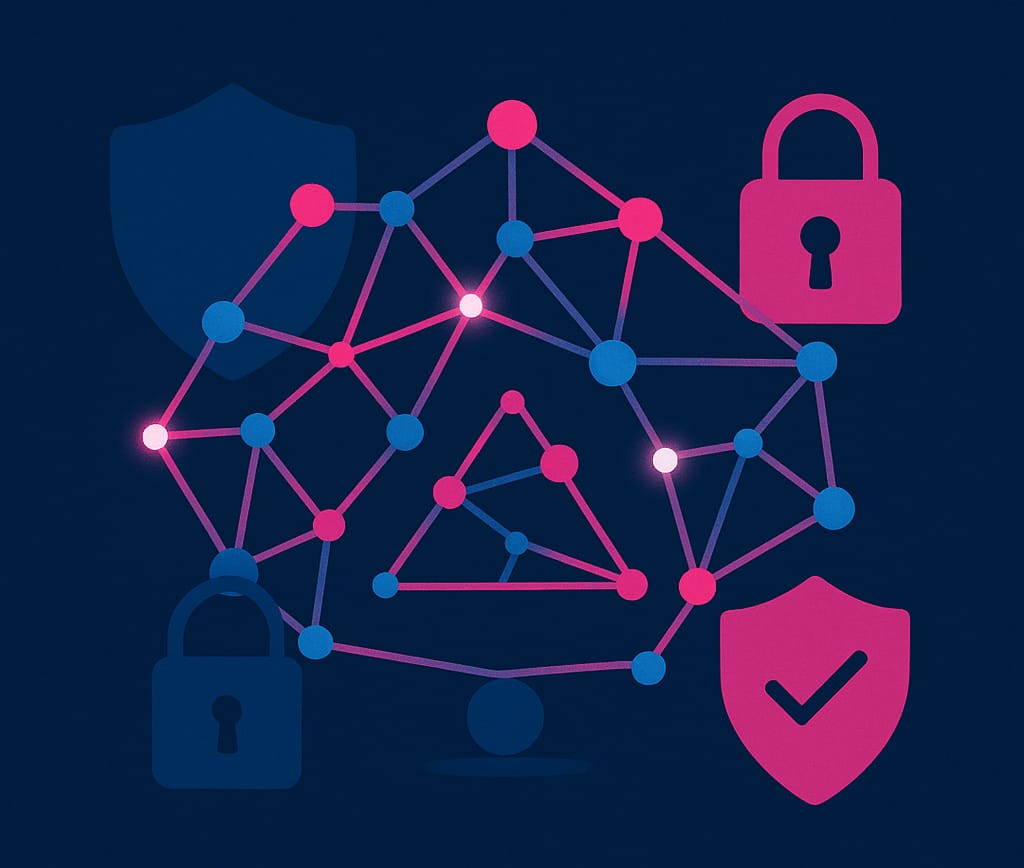
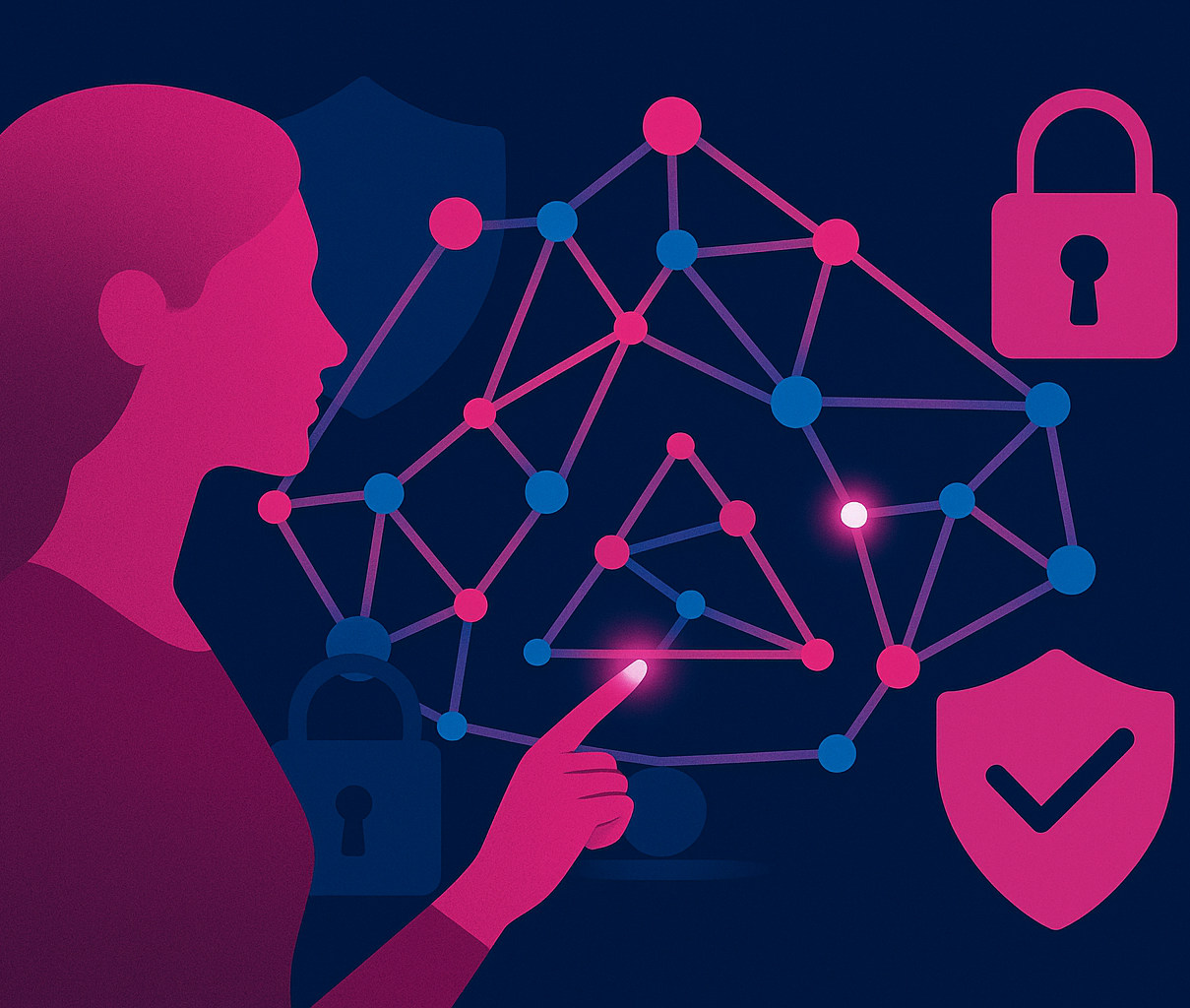
    AI trust and AI TRiSM, a woman printing to a node network featuring a padlock and a shield with a check mark.

    Building trust in complex systems is essential. See how Decision Lab builds trust into projects from the start using the AI TRiSM framework.

    The Decision Lab Perspective

    The methods outlined by Siefen and van der Velden at the Gurobi Summit confirm that the technology to build antifragile systems is already here. We see the future of supply chain planning as range-based experiment-driven. Indeed, Gartner recently recognised Decision Lab as a representative provider in an Innovation Insight report.

    On the journey from fragile, through resilient, to antifragile, we recognise the speed and power of Gurobi’s world-class solver, leveraging its capabilities for solutions to supply chain and defence related challenges. By combining Gurobi’s proven methods with a strategic focus on antifragility, we help our partners stop fearing uncertainty and start using it to their advantage.

    As a Trusted Partner, we offer Gurobi Compass training. It allows teams to integrate solutions and make the most of the solver quickly, whatever challenges they seek to resolve.

    Our Antifragility C-Suite Roadmap for supply chain from Decision Lab CEO David Buxton. Get your copy

  • Planning Your Career? Join Decision Lab at the OR Society’s Virtual Careers Week 2025

    Planning Your Career? Join Decision Lab at the OR Society’s Virtual Careers Week 2025

    We are thrilled to announce that Decision Lab will be speaking at The OR Society’s upcoming Virtual Careers Week (11-13 November 2025).

    This online event is a key date for students and graduates in Operational Research, data science, and analytics who are looking to plan their next steps and connect with leading employers.

    We invite you to join the session from our consultant, Disa Ray, on the first day of the fair.

    • Talk Title: From Student to Consultant: How I Landed the Job and What I’m Learning Now
    • Date: Tuesday, 11th November 2025
    • Time: 12:00 – 12:30 GMT

    What to Expect from the Session

    Making the leap from university to a career related to OR can be daunting. As a recent graduate herself, Disa will provide a practical, first-hand guide to the entire process.

    This session is ideal for students seeking an honest, relatable look at launching their careers. Disa will share actionable advice on:

    • How to build a standout application and CV that gets noticed.
    • Successfully navigating technical and competency-based interviews.
    • An honest look at the first 12 months in a consultancy role – including the challenges and the learning curve.
    • The essential on-the-job skills needed for long-term success.

    Why Start Your Career at Decision Lab?

    Disa’s session is a fantastic chance to learn about the culture and opportunities at Decision Lab. We are not just a leading OR consultancy; we are at the forefront of data science innovation.

    We are incredibly proud to have been recently named by Gartner in their Innovation Insight report on Experiment-Driven Supply Chain Planning. (Get your free copy while you can)

    Joining our team means working alongside industry-leading experts to solve complex, high-impact problems for major organisations. It’s a place where you can apply your academic skills from day one and see the real-world impact of your work. (See our careers page)

    How to Join

    Registration for the OR Society Virtual Careers Week is free and open to all.

    Don’t miss this opportunity to get practical career advice from Disa and learn more about the future of OR.

    Click here to register for the event

    We look forward to seeing you there!

    If you would like to see what roles are open with us at Decision Lab, check out our Careers page!

  • Trust in AI systems

    Trust in AI systems

    By Anahita Bilimoria, Decision Lab Innovation Practice Lead

    An essential framework for Responsible AI Deployment

    In this blog post, we dive deeper into the AI TRiSM principle of Trust. Together, the principles of AI TRiSM (Trust, Risk, and Security Management) add transparency, understandability, and reliability to our AI systems.

    Continuing from our previous blog on AI TRiSM, Building Trust in the Age of Artificial Intelligence, where we took a holistic view of the three core pillars of AI TRiSM, this blog post dives deeper into the principle of Trust. Welcome to part two of our AI TRiSM series: Trust in AI systems.

    The Foundation of Adoption: Building Trust in AI

    AI has integrated into our daily lives in unprecedented ways, from using Gemini or ChatGPT to summarise reports to utilising tools like Google’s NotebookLM for learning. However, the reliability of answers given by AI systems often remains uncertain. While we confidently ask a Language Model for code, broad trust in AI systems is still a major concern.

    In the context of AI, a more fitting definition may be: the attitude that an AI agent will help achieve an individual’s goals in a situation characterised by uncertainty and vulnerability. Clearly, building trust goes beyond simple belief in their capabilities—AI chatbots can seem remarkably confident. Rather, we must establish a calibrated trust: confidence that an AI system will behave reliably, ethically, and securely, leading to intended outcomes while understanding its limitations. For the human in the system, this confidence operates on two crucial dimensions:

    • Cognitive Trust: based on evidence, competence, and reliability. Confirmed by performance metrics such as accuracy, loss, and F1 score, ensuring the system works as expected. Answers the question: can I trust it?
    • Emotional Trust: based on comfort, security, and ethical alignment. The confidence that the system aligns with moral or societal values and will not discriminate against users. Answers the question: do I want to trust it?

    The goal of AI TRiSM is to foster a balanced level of trust across these dimensions, steering clear of algorithm aversion (distrusting a competent system) and automation complacency (over-relying on a flawed system). Trust in AI is not a single feature but the culmination of several measurable and governable qualities. The AI TRiSM framework tackles these factors by providing actionable strategies:

    1. Explainable and Transparent (XAI)

    The defining challenge for trust is the ‘Black Box’ nature of modern, complex AI models. If a system’s decision cannot be understood or audited, it fundamentally cannot be trusted.

    Explainable AI (XAI) addresses this by providing insight into how and why a model reached a specific output. This is essential not just for a user’s peace of mind, but for auditing, compliance, and legal accountability.

    How it can be achieved:

    • Employing Inherently Interpretable Models: Using simpler models (like linear regression or decision trees) when complexity isn’t strictly necessary. Utilising inherent white-box models such as NeSy models (Neurosymbolic AI) and Causal ML routes that provide complete knowledge graphs of model knowledge.
    • Providing Decision Tracing: Logging all input features and intermediate steps that lead to an outcome, allowing stakeholders to trace a decision back to its source. Applying methods like SHAP (SHapley Additive exPlanations) or LIME (Local Interpretable Model-agnostic Explanations) to complex models to generate human-readable justifications for individual predictions.

    2. Fairness and Bias Mitigation

    AI models are trained on data, and that data reflects historical and societal biases. Consequently, models are prone to inheriting these biases, leading to discriminatory or unfair outcomes. This directly breaks emotional trust. Building trust requires active and continuous steps to ensure fairness.

    How it can be achieved:

    • Pre-Processing Bias Mitigation: Conducting thorough Exploratory Data Analysis (EDA) to identify and balance data imbalances before model training (e.g., re-sampling minority classes).
    • Model Bias Mitigation: Implementing constraints during the training process that penalize the model for differential performance across different demographic groups. Defining and monitoring multiple fairness metrics (like equal opportunity or demographic parity) after deployment to ensure equal outcomes across protected groups, going beyond simple overall accuracy.

    3. Reliability, Robustness, and Safety

    A trusted system must be dependable. Reliability is its ability to perform consistently and accurately under normal operating conditions. Robustness ensures the model’s accuracy is maintained even when facing slight variations or unexpected inputs. The final layer is Safety, which protects against catastrophic failure.

    How it can be achieved:

    • Continuous Model Operations (ModelOps): Implementing automated systems to monitor model performance in real-time, catching model drift (when performance degrades over time) or degradation after deployment.
    • Stress Testing and Adversarial Training: Rigorously testing the model with malicious inputs and unexpected data shifts to improve robustness against adversarial attacks.
    • Human-in-the-Loop Controls: Equipped with safeguards like “kill switches” and defined pathways for human intervention to ensure an autonomous system can be overridden or stopped when faced with an unsafe or ambiguous situation.

    4. Privacy and Data Protection

    In the age of vast data collection, a user’s willingness to use an AI solution hinges on the assurance that their sensitive information will be protected. Trust is lost if data is compromised, misused, or leaked. Adhering to regulations like GDPR and CCPA is a baseline.

    How it can be achieved:

    • Secure-by-Design Principles: Initiating and maintaining AI solution development that incorporates techniques such as anonymisation and data minimisation (minimum necessary data collection).
    • Privacy-Enhancing Technologies (PETs): Utilising advanced cryptographic techniques like federated learning (training models on decentralised data) to protect sensitive information during training and inference.
    • Access Control and Security Audits: Implementing strict access controls and regular security audits for data pipelines and model APIs to ensure compliance and prevent unauthorised data access.

    The Value of Proactive Trust Management

    The journey of AI adoption is paved with the potential for misuse and technical failure. A single, high-profile failure, such as a biased recommendation, a security breach, or a dangerous hallucination, can instantly erode years of trust-building effort.

    By embracing the Trust component of AI TRiSM, organisations can move from reactive damage control to proactive trust management. They can operationalise these ethical and performance requirements, embedding them into the entire solution lifecycle.

    Investing in these principles is an investment in the long-term viability of AI, ensuring that as systems become more autonomous and integrated into our lives, they remain aligned with our values, transparent in their operations, and secure with our data. This is how we build systems that don’t just perform a task reliably, but adapt and improve in a volatile world. This concept is particularly critical in complex, high-stakes environments like supply chain management, where disruption is a constant threat.

    For a deeper exploration of how these principles are applied to create systems that gain from disorder, see our recent white paper: Beyond Resilience: Engineering the Anti-Fragile Pharma Supply Chain of 2030.

    The next in the AI TRiSM series: Moving From Theory to Action with Risk Management

    Author: Anahita Bilimoria, Decision Lab Innovation Practice Lead.
    Follow this series on AI TRiSM from Decision Lab, follow us on LinkedIn!

  • Your Supply Chain Was Built for Yesterday’s World. Here’s the Playbook for Tomorrow’s

    Your Supply Chain Was Built for Yesterday’s World. Here’s the Playbook for Tomorrow’s

    As a supply chain leader, you’re judged on one thing: your ability to guarantee outcomes in a world that offers none. For years, the accepted strategy was resilience—building a fortress to withstand disruption. But the old playbook is failing.

    You see the cracks every day. You’re the one who has to:

    • Justify High-Stakes CAPEX: Stand behind multi-billion-dollar investment models, knowing they are built on brittle, single-number forecasts that ignore real-world volatility.
    • Own Production Failures: Answer for critical programme delays and missed launch targets when the escalating complexity of new therapies breaks your traditional scheduling processes.
    • Carry Network Risk: Live with the constant threat of a fragile supply network, where a single failure at a tier-2 supplier can halt production on your watch.

    Continuing to invest in resilience is like reinforcing the walls of a fortress when the nature of the battle has changed. It’s time for a new, offensive strategy: antifragility. An antifragile supply chain doesn’t just recover from shocks; it harnesses their energy to become stronger, faster, and more intelligent. It’s a strategic lever that turns volatility from a threat into a competitive weapon.

    Our new white paper, ‘Beyond Resilience: Engineering the Anti-Fragile Pharma Supply Chain of 2030,‘ is a C-suite briefing on how to build this capability. It provides a concrete, actionable 3-phase roadmap for deploying the AI and Digital Twin technologies needed to de-risk investments, master complexity, and create a truly adaptive network.

    Stop reinforcing yesterday’s defences. Start engineering tomorrow’s advantage.

  • Simulating the Future of Venetian Clams

    Simulating the Future of Venetian Clams

    Join Our Collaborative Talk at AnyLogic 2025

    The Venice Lagoon is not only a world heritage site but also home to a crucial industry: Manila clam harvesting. This vital economic and ecological resource is facing an unprecedented threat from climate change, with rising water temperatures posing a significant risk to the clam population’s survival.

    How can we predict the long-term impact and help safeguard this industry?

    Decision Lab is proud to have supported researchers from the Fondazione Eni Enrico Mattei (FEEM) and Ca’ Foscari University of Venice in tackling this very question. We invite you to join us at the AnyLogic Conference 2025 for an insightful presentation on their groundbreaking work.

    The Presentation: A Hybrid Model for a Complex Problem

    Federico Cornacchia and Dr. Sebastian Raimondo of FEEM will present their project:

    ‘Climate Risk in Provisioning Ecosystem Services: An Explorative Hybrid Model of Adaptive Behaviour in Clam Harvesting’.

    Their research showcases a powerful hybrid simulation model built in AnyLogic that explores the complex interplay between environmental changes and human behaviour. The model combines:

    • System Dynamics: To simulate the biological life cycle of the clams, including their growth, population dynamics, and mortality rates linked to rising water temperatures.
    • Agent-Based Modelling: To simulate the decision-making of individual clam harvesters, who must constantly weigh market prices against the growing thermal risk to their stock.

    This is a fantastic opportunity to see how advanced modelling techniques can provide tangible insights into the economic viability of an entire sector and support decision-making for resource managers under climate uncertainty.

    Our Collaborative Role

    At Decision Lab, we are passionate about using simulation to solve real-world problems. We were delighted to contribute to this important project, with our own Adam Coleman providing technical AnyLogic support and bespoke training from our Learning Lab to the FEEM research team. This collaboration highlights the power of sharing expertise to drive innovation in climate adaptation strategies.

    Meet the Speakers

    The presentation will be led by two distinguished researchers from FEEM:

    • Federico Cornacchia: A researcher pursuing his PhD in Science and Management of Climate Change. Federico specialises in modelling complex socio-ecosystems, with a focus on adaptive natural resource management and sustainability.
    • Dr. Sebastian Raimondo: An environmental engineer and complex systems scientist. Dr. Raimondo is in charge of developing mathematical modelling tools to support decision-making for climate change adaptation strategies.

    Join Us at the Conference

    Don’t miss this compelling look into the future of climate adaptation modelling.

    • Event: The AnyLogic Conference 2025
    • Title: Climate Risk in Provisioning Ecosystem Services: An Explorative Hybrid Model of Adaptive Behaviour in Clam Harvesting
    • Speakers: Federico Cornacchia & Dr. Sebastian Raimondo
    • Date & Time: 9 September 2025, 12:30 BST (UTC+1)
    • Location: Online

    We look forward to seeing you there and exploring how simulation can help us build a more resilient future. And, don’t miss our other presentation at the conference this year: Engineering the Antifragile Supply Chain.

    The work will also be presented in Salerno on Thursday 23 October 2025 at the conference SISC2025: Innovation in climate research for societal transformation in the session Governing for Climate Resilience. More info on the Società Italiana per le Scienze del Clima (SISC) conference website.

  • Engineering the Antifragile Supply Chain

    Engineering the Antifragile Supply Chain

    A Sneak Peek into Our AnyLogic 2025 Presentation

    The pharmaceutical industry is in a constant state of flux. Global disruptions, shifting demand, and a complex regulatory landscape mean that traditional supply chain management is no longer enough. To thrive, companies need to move beyond resilience and embrace antifragility – the ability to not just withstand shocks, but to emerge stronger from them.

    At Decision Lab, we’re proud to be at the forefront of this paradigm shift. We’re excited to announce that our very own Modelling and Optimisation Consultant, Disa Ray, will be co-presenting at the AnyLogic Conference 2025 alongside Gareth Alford, New Technology Innovation Director at AstraZeneca.

    Their presentation, ‘Engineering the Antifragile Supply Chain: How AstraZeneca and Decision Lab Built a Strategic Digital Twin for Multi-Region Capacity Planning, will delve into our groundbreaking collaboration with AstraZeneca to revolutionise their capital allocation and capacity planning.

    The Challenge: From Reactive to Proactive

    AstraZeneca, a global pharmaceutical leader, faced a common challenge: making high-stakes investment decisions based on slow, fragmented, and error-prone spreadsheet-based planning. This reactive approach made it difficult to anticipate future demand, optimise their network, and navigate the intricate web of industry compliance, including adherence to Good Manufacturing Practice (GMP) and regulations set by bodies like the MHRA.

    The Solution: A Strategic Digital Twin

    In partnership with AstraZeneca, we developed a Strategic Digital Twin of their supply chain. This innovative solution integrates three powerful, interconnected simulation models—Portfolio, Demand, and Capacity—into a unified, web-based platform. The digital twin allows senior leadership to simulate a decade of operations under thousands of scenarios. This robust modelling can provide the evidence needed to support a successful Marketing Authorisation (MA) and enhance overall Commercial Effectiveness, supporting high-stakes investment decisions with evidence-based strategy.

    What You’ll Learn

    Attendees of the presentation will gain valuable insights into:

    • How to move from reactive, single-point forecasting to proactive, range-based planning.
    • The power of a unified, web-based platform for strategic decision-making that improves market access.
    • How to de-risk CAPEX, optimise your network, and turn uncertainty into a competitive advantage.
    • The practical aspects of implementing Pharma 4.0 technologies while maintaining strict regulatory compliance.

    Meet the Speakers

    • Disa Ray is a Consultant at Decision Lab with a background in Information Technology and Artificial Intelligence. She has extensive experience in full-stack software development, user interface design, DevOps, and machine learning.
    • Gareth Alford is the New Technology Innovation Director at AstraZeneca, where he focuses on intensifying API development through to manufacturing. With over 25 years of experience in the pharmaceutical sector, Gareth has been instrumental in creating modular systems that are fit for both manufacturing and R&D.

    We invite you to join us at the AnyLogic Conference 2025, 9 September 2025, to learn more about this transformative project. This session will take place at 4 PM BST (UTC+1).

    In the meantime, you can read our case study on the project here.

  • Antifragility — Beyond Resilience

    Antifragility — Beyond Resilience

    How to Engineer an Antifragile Business That Thrives on Disruption

    In today’s business landscape, disruption isn’t a rare event. We might even think of it as a new constant. For years, leaders have championed resilience and the ability to take a hit and bounce back to normal. But in a world of perpetual volatility, simply returning to a constantly shifting baseline is a strategy for stagnation, not leadership. The goalposts have moved.

    The new strategic imperative is antifragility.

    Coined by author Nassim Nicholas Taleb, antifragility describes a system that doesn’t just survive shocks but takes learnings from them, enabling improvement. While a resilient company weathers the storm, an antifragile one harnesses the storm’s energy to become stronger, more profitable, and pull ahead of the competition.

    This isn’t a theoretical buzzword. Well implemented, antifragility is a measurable competitive advantage. The problem? Gartner research reveals a stark reality: 63% of supply chains are fragile, meaning they lose value under stress. A mere 6% have achieved an antifragile state.

    This post will explain how to bridge that gap. Antifragility is something that must be worked on: an engineered capability built on the foundations of two transformative technologies: probabilistic Digital Twins and Agentic AI.

    What is Antifragility, Really?

    To understand antifragility, it helps to see it on a spectrum:

    A diagram of the Uncertainty Spectrum, showing the progression from a Fragile state (suffers from uncertainty) to a Resilient state (resists uncertainty) to an Antifragile state (gains from uncertainty).
    • Fragile: Unable to sustain itself, it breaks under the pressure of turbulent times. Its processes are optimized for a single, stable reality that no longer exists.
    • Resilient: Able to survive disruptions for a certain period. It has buffers and contingency plans designed to absorb shocks and return to the status quo.
    • Antifragile: Poised to become stronger from disruption. It is designed to learn from chaos, adapt, and capture opportunities that cripple its fragile and resilient competitors

    The critical difference lies in how an organisation uses technology to make decisions under pressure. Many companies invest heavily in visibility, hoping to see disruptions coming. Yet, research has shown that without an intelligent system to act on the data, more visibility can simply create more noise, overwhelming decision-makers and even negatively impacting performance. Antifragility isn’t about seeing the future with perfect clarity; it’s about building a system that is prepared to act optimally across a wide range of possible futures.

    Moving an organisation along this spectrum from a fragile to an antifragile state requires a new cognitive architecture for decision-making. For a detailed guide on the four pillars of this transformation, download our complete white paper.

    The Blueprint: Engineering Antifragility with Digital Twins and Agentic AI

    Achieving an antifragile state requires a new kind of bespoke decision engine, combining strategic foresight with autonomous action.

    1. The Foresight Engine: Probabilistic Digital Twins

      A true Digital Twin is not just a simulation model. It’s a dynamic, data-fed virtual replica that may capture your production lines, supply networks, logistics, and financial structures. Its purpose is to serve as a dynamic mirror of your business.

      Instead of waiting for a crisis, you can use a Digital Twin to understand uncertainties, proactively stress-testing your operations against thousands of ‘what-if’ scenarios in a risk-free environment: What happens if a key supplier goes offline? What’s the impact of a sudden 40% demand surge? How would a change in carbon tax affect profitability?

      By running these simulations, leaders can move beyond single-point forecasts and begin to map the entire decision landscape. This makes complex trade-offs between cost, service, and risk transparent and quantifiable, providing the robust business case needed to justify strategic investments and de-risk major decisions.
    2. The Action Engine: Agentic AI

      Foresight is useless without action. This is where Agentic AI comes in. Unlike analytical AI that simply provides insights, an AI agent is a goal-oriented system that can perceive its environment, reason, and take autonomous action to achieve its objectives. It closes the critical gap between knowing and doing.

      Working in a continuous loop, the AI agent can:
      • Sense: Monitor real-time data from your operations and the Digital Twin.
      • Plan: When a disruption occurs, it references the thousands of pre-simulated scenarios in the twin to instantly identify the optimal response.
      • Act: It autonomously executes the plan by interacting with your existing enterprise system, such as to adjust a production schedule in your ERP, reroute a shipment in your TMS, or reallocate inventory in your WMS.  
      • Learn: It feeds the outcome back into the Digital Twin, making the entire system smarter and more adaptive over time.

    The synergy is profound. Digital Twins provide a strategic playbook for any eventuality ,while AI Agents execute the right play in real-time.

    Antifragility in Action: A Scenario

    Imagine a sudden demand surge for one of your products after a competitor’s factory suffers an outage.

    A fragile or resilient company scrambles. Planners huddle over spreadsheets, trying to manually re-calculate production schedules and material flows. By the time they react, the opportunity has shrunk.

    The antifragile company thrives. Its Digital Twin has already simulated this type of event. The moment the demand signal is detected, a trusted AI agent autonomously queries the twin, identifies the optimal response, and executes it. It instantly re-optimises production schedules, reallocates capacity across multiple lines, and triggers new material orders. All this is achieved before the competition has even finished their first meeting. The company not only captures the immediate sales but gains permanent market share from customers failed by its competitors. It has gained value directly from the disorder.

    This is comparative antifragility in action: emerging stronger, relative to competitors, from the very same disruption.

    The era of simply weathering the storm is over. The future belongs to those who can build the operational capability to harness its power. By integrating the foresight of Digital Twins with the autonomous execution of Agentic AI, leaders can move beyond resilience and engineer a truly antifragile enterprise that is built to win in a world of constant change.

    You now understand why antifragility is the new competitive frontier. The pharmaceuticals industry is at the front line. To move from theory to practice download our exclusive white paper, Engineering the Anti-Fragile Pharma Supply Chain of 2030, for an actionable C-suite roadmap to building a supply chain that thrives on disruption.

  • AI TRiSM: Building Trust in the Age of Artificial Intelligence

    AI TRiSM: Building Trust in the Age of Artificial Intelligence

    By Anahita Bilimoria, Decision Lab Senior Machine-Learning Engineer

    An Essential Framework for Responsible AI Deployment

    The promise of Artificial Intelligence is immense, offering solutions to humanity’s most pressing challenges. With the recent boom of Language Models and AI penetrating every domain, we are confronted with a fundamental truth: global adoption and subsequent progress rely solely on trust. While the performance of AI in every aspect of automated decision-making is phenomenal, there has been a rising concern for trust in AI, fueled by opaque decision-making and perceived biases. This challenge has given rise to stalled innovation, public apprehension and the risk of deploying technologies without adequate oversight. The urgency to build and maintain trust in AI has surpassed being simply a matter of ethics and has given rise to safety concerns as well.

    Despite adaptive speed and response, autonomous AI’s unchecked deployment can lead to instability. The absence of clear dependability metrics and inadequate interpretability methods raise trust questions across diverse AI. Although some transparent AI exists, rapid critical adoption in a volatile environment, coupled with regulation and public concern, necessitates urgent trust-building. AI TRiSM provides a repeatable framework (trust, security, privacy, transparency) to address these risks.

    What is AI TRiSM?

    Gartner, a leading research and advisory company, defines AI TRiSM (AI Trust, Risk and Security Management) as a framework that ‘ensures AI model governance, trustworthiness, fairness, reliability, robustness, efficacy, and data protection’. This ensures that models that follow this framework are not unethical, unfair or biased. While most AI solutions focus on model performance, AI TRiSM adds a layer of model responsibility, urging developers to strike a balance between the two.

    A hexagonal diagram illustrating key metrics for AI Model Performance, a core component of AI-TRiSM. Metrics shown include accuracy, F1 score, loss, and precision.
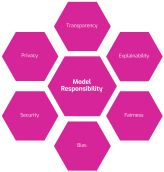
    A diagram of AI Model Responsibility's core components. A central hexagon is surrounded by six related principles: Transparency, Explainability, Fairness, Bias, Security, and Privacy.

    Figure 1: Balancing Model Performance and Model Responsibility. This diagram illustrates the key metrics associated with traditional AI Model Performance (such as Accuracy, F1 score, and Loss) in contrast with the crucial metrics for Model Responsibility (including Transparency, Explainability, Fairness, and Security) that are central to AI TRiSM.

    Despite being a framework of individual principles, AI TRiSM enables the fulfillment of each principle through conscious and targeted steps.

    Trust

    Entailing the concepts of transparency, fairness, reliability, privacy and safety; this pillar ensures that models offer accountability and build trust. This component of AI TRiSM requires models to offer explainability, either by using Explainable AI (xAI), which are models designed to be interpretable, or artificially inducing explainability in their decision-making processes. Models trained on data are prone to biases in the data itself, leading to discriminatory model outcomes. Techniques like a thorough Exploratory Data Analysis (EDA) – which involves visualizing and summarizing data to spot imbalances – and bias detection methods can help gain insight into the biases in data. Regulations like GDPR and CCPA ensure data privacy and security. While models can’t follow these regulations directly, you can ensure your AI solution does by implementing appropriate data handling and storage practices! Autonomous solutions can build trust by introducing kill switches, pathways for human intervention, and safe operation mechanisms to ensure safe execution even in unexpected situations.

    Risk

    This pillar involves identifying and managing risks associated with your AI solution throughout its lifecycle. You can map up the risks associated with your solution. Some key aspects can include:

    • Performance risks (e.g., model drift, accuracy degradation)
    • Ethical risks (e.g., bias, lack of fairness)
    • Security risks (e.g., adversarial attacks, data breaches)
    • Operational risks (e.g., deployment failures, integration issues)

    The solution lifecycle must include allocated resources for identifying, evaluating, and mitigating risks proactively throughout the solution’s development and deployment. Identifying these risks proactively helps stakeholders make informed decisions about the deployment and ongoing use of the AI solution. Ensuring the risk register includes all potential risks will highlight the potential gaps in your solution and enable mitigation strategies. Your team can have established roles, responsibilities, and policies for managing AI risks effectively.

    Security

    Each type of AI comes with its own security issues, like adversarial attacks (subtly changing input data to fool the AI), data poisoning (injecting malicious data to corrupt training), and model stealing (recreating a proprietary model). Achieving security in the model performance involves achieving security throughout the solution lifecycle, following a ‘Security by design’ approach to developing your solution. One must secure their data (incoming and outgoing), adopt techniques to protect the AI models, infrastructure, and APIs. While this principle shares its goal with standard security for software solutions, in AI TRiSM this also means making sure your model is not ‘hackable’ in ways specific to AI vulnerabilities.

    How can you adopt AI TRiSM as a company?

    While developers can tackle components individually, companies can also embrace it as a complete framework. The following steps outline how your company can introduce AI TRiSM to your organisation:

    • Adopt AI TRiSM across your entire solution lifecycle (discovery to evaluation), documenting observations and decisions in a final report. A company-wide template standardizes AI TRiSM implementation for all projects.
    • Ensure company-wide awareness of AI TRiSM through clear communication channels. Document model audits and communicate identified risks with proposed mitigation strategies to relevant stakeholders.
    • Provide thorough training and education on AI TRiSM principles and practices across the organization, perhaps through workshops or online modules.
    • Establish partnerships with entities that have a strong focus on AI TRiSM to leverage their expertise and insights.

    Employing TRiSM in AI offers several key benefits, including building trust in AI systems, mitigating potential risks through pre-emptive resolution, ensuring compliance with evolving regulations, and fostering sustainable and transparent AI growth.

    This post has provided an overview of AI TRiSM and its critical role in the responsible development and deployment of AI. In upcoming articles, we will delve deeper into each of the core pillars – Trust, Risk, Security, and Transparency – exploring the specific challenges, techniques, and best practices associated with building trustworthy AI systems.

    Investing in AI TRiSM is an investment in the long-term value and viability of AI. By embedding these principles into our processes, we build a foundation of trust that will be crucial for the continued adoption and positive impact of artificial intelligence!

    Next Steps

    Navigating the complexities of AI TRiSM – ensuring trust, managing risk, and maintaining security – is crucial for successful AI adoption. At Decision Lab, we are committed to developing AI solutions that inherently incorporate these principles from design to deployment.

    Our deep expertise in Explainable AI (xAI) provides the transparency needed for user confidence and regulatory compliance, directly addressing the ‘Trust’ pillar. We specialise in creating effective Human-AI Teaming paradigms, designing systems where human insight complements automated decision-making, ensuring robust operation and essential oversight to mitigate ‘Risk’.

    Furthermore, our development processes are underpinned by strict adherence to rigorous ISO standards, demonstrating our commitment to ‘Security’, reliability, and quality across all our AI solutions. Partner with Decision Lab to build AI systems that are not only high-performing but also fundamentally trustworthy, secure, and aligned with responsible innovation principles.

    To explore how Decision Lab’s AI solutions can benefit your organisation, get in touch. Let’s unlock the full potential of AI.

    The next post in the series Trust in AI Systems: An essential framework for Responsible AI Deployment.

    Author: Anahita Bilimoria, Decision Lab Senior Machine Learning Engineer
    For further updates from Decision Lab, follow us on LinkedIn!

  • Logistics Optimisation: LOGOS+

    Logistics Optimisation: LOGOS+

    Solving the Interdependent Challenges of Packing Fitness and Delivery Distance

    In global distribution, operational efficiency is a balancing act between conflicting physical realities. To maximise margins, supply chain leaders are constantly caught between two critical metrics: packing fitness (how densely items are secured within a vehicle) and delivery distance (the total mileage of the transportation route).

    For any commercial fleet, the core objective is simple: deliver inventory from a central hub to multiple destinations at the absolute lowest total cost. Yet, when executed on an enterprise scale, material costs (pallets, vehicle overheads) and transport costs (fuel, driver hours) frequently pull operations in opposite directions.

    To achieve true capital efficiency, decision-makers can no longer afford to evaluate packing and routing in isolation. They must be solved simultaneously.

    The Costly Reality of Fragmented Models

    Traditionally, logistics architecture has relied on the Separated Packing and Routing (SPR) model. This legacy approach treats the Bin Packing Problem (BPP) and the Vehicle Routing Problem (VRP) as two entirely independent workflows managed by separate teams.

    While the SPR model offers administrative simplicity, it introduces two critical operational flaws:

    • Conflicting Corporate Objectives: Packing teams focus entirely on minimising fixed asset and pallet usage, while dispatch teams focus solely on reducing mileage. Without a unified framework, these goals directly undermine each other.
    • The 20% Cost Penalty: Because packing configurations are finalised before routing algorithms begin, vital destination and drop-off sequence data are completely excluded from the initial loading phase. This structural blind spot creates systemic delivery bottlenecks and highly sub-optimal routes.

    The Computational Bottleneck

    The obvious alternative is an integrated model powered by Mixed Integer Programming (MIP). When paired with advanced mathematical solvers like Gurobi, MIP models can guarantee a mathematically flawless, optimal solution.

    However, exact mathematical modeling suffers from exponential computational scaling. For an enterprise fleet managing 1,000 boxes across 100 destinations, calculating a perfect MIP solution could literally take years of computing time. In live logistics environments where windows are tight, this approach is commercially unfeasible.

    Introducing LOGOS+: Next-Generation Hyper-Heuristics

    To bridge the gap between mathematical idealism and real-world operational velocity, Decision Lab developed LOGOS+ (Logistics Optimisation System — Two-Level Capacitated Vehicle Routing Problem, or LOGOS-2S-CVRP).

    LOGOS+ is a proprietary hyper-heuristic framework that bypasses exponential computing delays. By combining two distinct algorithmic classes, it delivers near-optimal operational plans in seconds.

    1. Constructive Heuristics

    This layer builds a highly viable, baseline operational solution from scratch using two distinct, configurable strategies:

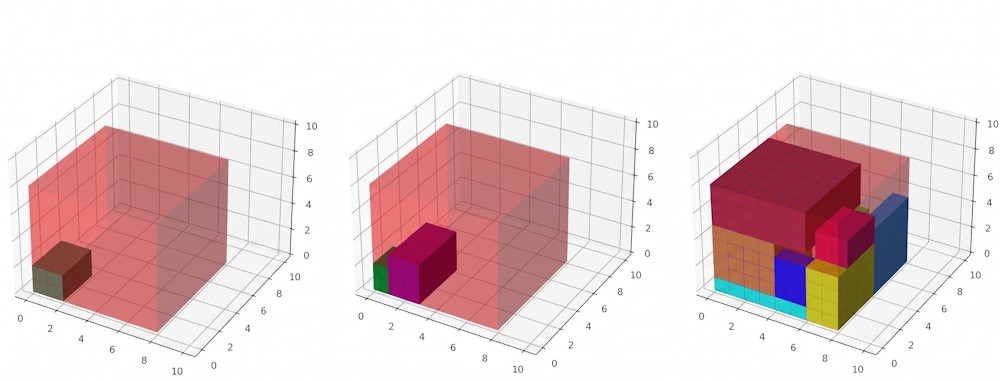
    • Volume-Driven (VD) Heuristics: Prioritises the minimisation of material and pallet costs. Items are systematically sorted and packed into vehicles based on customisable, high-scoring geometric constraints.
    A three-part scientific diagram demonstrating a step-by-step 3D bin packing problem solution, showing an open bounding box grid sequentially filled over three stages with colourful, tightly packed cuboid items to maximize spatial utility.
    LOGOS+ 3D Bin Packing Volumetric Space Mapping
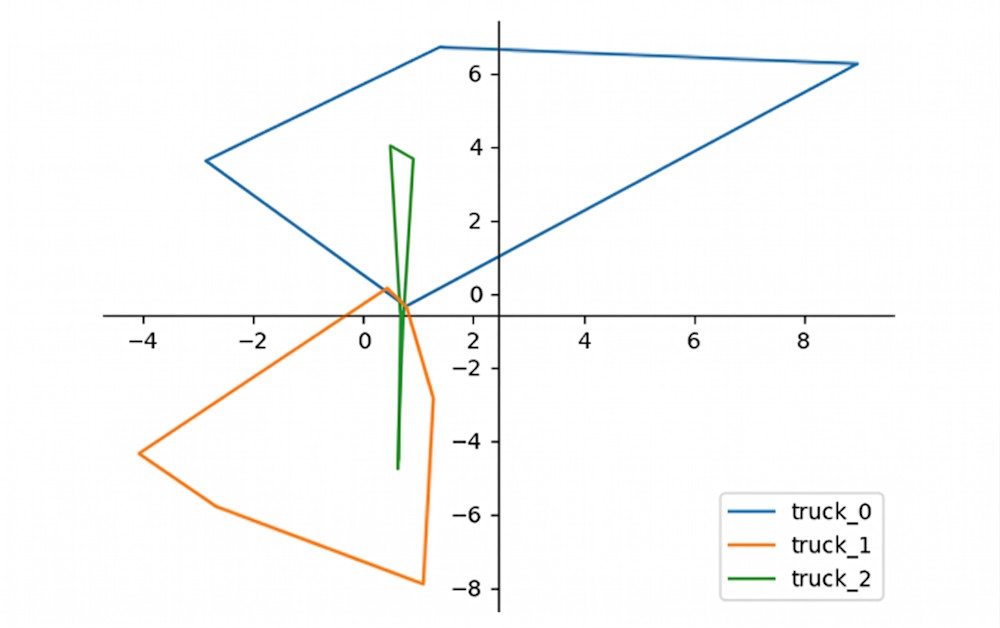
    • Destination-Driven (DD) Heuristics: Prioritises transportation efficiency. The engine automatically clusters items by geographic proximity or pre-loads containers to perfectly align with the intended multi-drop sequence.
    A technical line chart plotted on an X-Y axis demonstrating vehicle routing clusters for three separate vehicles, labeled truck_0, truck_1, and truck_2, showing how delivery destinations are partitioned into distinct, optimised spatial zones to minimise transit distances.
    LOGOS+ Geographic Clustering and Vehicle Routing

    2. Perturbative Heuristics

    Once the initial solution is constructed, LOGOS+ deploys advanced local search and hill-climbing algorithms to eliminate hidden inefficiencies. The engine continuously optimises the fleet layout via four core operators:

    Packing Swap: Exchanging assets between two vehicles to achieve a superior volumetric fit.

    Packing Insert: Shifting an individual item to an alternative vehicle to maximise space utilisation.

    Degrading: Completely unloading a under-utilised vehicle and resetting its contents across the remaining fleet.

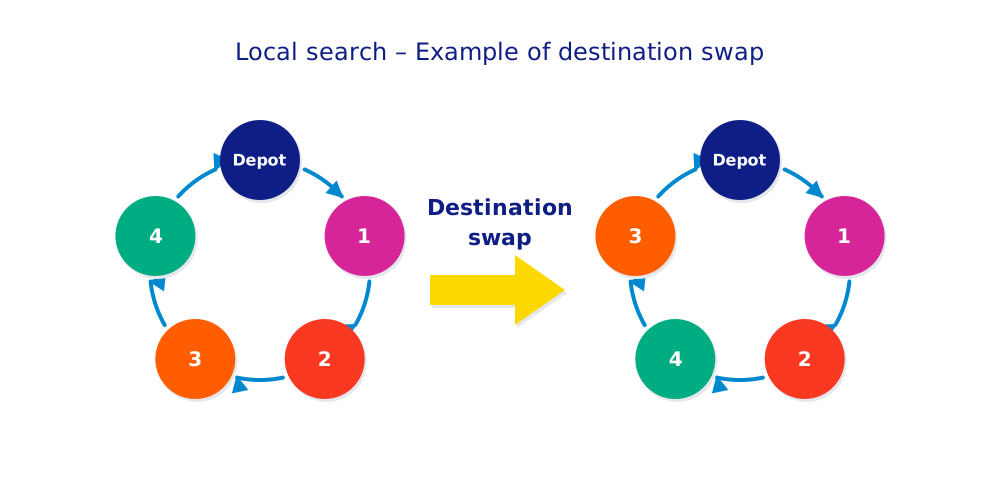
    Destination Swap: Altering the drop-off sequence within a single vehicle’s manifest to uncover a shorter, faster transit path.

    A technical workflow diagram demonstrating a local search optimization technique where a multi-drop delivery route originating from a central depot has its sequence modified by a destination swap between two stops to refine transit efficiency.

    The system iterates automatically, accepting a new layout only if it actively reduces total operational expenditure, until a refined local optimum is achieved.

    Proven Performance and Speed

    Through rigorous benchmarking against randomised enterprise datasets scaling up to 80 variables and 50 destinations, LOGOS+ demonstrated a massive leap forward in computational and financial performance.

    Optimisation MethodSolution QualityComputation TimeOperational Viability
    Separated Packing & Routing (SPR)Poor (Up to a 20% cost penalty vs integrated models)Very Fast (Seconds)High administrative ease, but poor financial efficiency.
    Mixed Integer Programming (MIP)Perfect (100% mathematically optimal)Extremely Slow (30+ mins for just 10 boxes)Commercially unfeasible for live, large-scale operations.
    LOGOS+ (Hyper-Heuristic)Excellent (Averages within 10% of true mathematical optimum)Instantaneous (Processes 1,000 boxes across 100 drops in 6.52 seconds)Ideal for real-time, large-scale enterprise logistics.

    Strategic Business Impact

    LOGOS+ represents a significant paradigm shift for enterprise supply chains. Rather than breaking logistics challenges apart (packing individual pallets, loading vehicles, and planning routes in silos) our engine processes them within a single, unified pipeline.

    By eliminating the traditional 20% cost penalty associated with fragmented planning, LOGOS+ allows organisations to tailor their optimisation core to match specific corporate KPIs:

    • Decarbonisation & Sustainability: Configure the system to explicitly minimise total CO2 emissions, automatically influencing optimal vehicle selection and routing configurations.
    • Bottom-Line Maximisation: Dynamically balance fuel consumption variables against fluctuating driver labor rates, clean-air zone fees, and service level agreements (SLAs).

    What’s Next: The AI Frontier

    While we are actively expanding our suite of heuristics, our next frontier is total intelligent automation. Decision Lab is currently developing an Artificial Neural Network (ANN) layer designed for automatic algorithm selection. Once deployed, this AI capability will instantly evaluate incoming logistics profiles and automatically select the absolute best heuristic combination for that specific dataset, unlocking true hyper-optimality without human intervention.

    LOGOS+ is architected to serve as the high-performance optimization engine powering modern supply chain and enterprise resource planning software.

    To learn how to integrate this capability into your logistics ecosystem, contact us.