

Why Gurobi’s Latest Keynote is a Blueprint for Antifragility
In the current landscape of supply chain and operational planning, the search for certainty is a losing battle. Yet, many organisations still build their strategies around static forecasts, hoping the world will comply with their spreadsheets.
At the recent EMEA Gurobi Summit in Vienna, a different path was illuminated. In their keynote Bold Choices, Proven Methods, Gurobi’s Dr. Kostja Siefen and Ronald van der Velden outlined a comprehensive framework for empowering confident decision-making. They effectively demonstrated that optimisation is not only a tactical tool for efficiency; it is a core method underpinning bold leadership. Their presentation encapsulated what we at Decision Lab recognise as Antifragility and the ability to not just withstand volatility, but to use it to gain a competitive edge.
While resilience is about surviving a shock, antifragility is about improving because of it. Siefen and van der Velden’s keynote perfectly articulated the mechanics required to build such a system. They argued that to move from tentative planning to bold action, organisations must master three specific areas: challenging the status quo, mastering the projects, and achieving business value.
Here is how Gurobi’s technical roadmap aligns with the strategic imperative of antifragility.
Resilience Over Prediction
One of the most dangerous traps in decision-making is the ‘illusion of certainty’. As noted in the keynote, “failures in planning and strategy often stem from misplaced confidence… rather than from making the ‘wrong’ decision”.
A fragile system assumes the forecast is correct. An antifragile system, however, relies on a Robustness Strategy. As their presentation articulated, the goal is not to eliminate uncertainty but to design processes that endure when reality diverges from expectations. By moving away from a single, unrealistic scenario and embracing uncertainty-aware optimisation, businesses can design plans that remain effective even when the unexpected happens.
Evolution Through Pacing
True antifragility is not achieved through a single ‘big bang’ implementation. It requires an Evolution Strategy, viewing the past and future not as opponents, but as partners.
The keynote speakers emphasised the importance of a Pacing Strategy, where change is introduced through focused stages that create momentum. Rather than demanding instant perfection, successful optimisation projects ‘start small, learn fast, and adapt’. This iterative approach allows an organisation to absorb stressors, such as data quality issues or stakeholder resistance, and use them to refine the model, making the final solution stronger and more fit for purpose.
The Art of Adaptive Focus
In the age of Digital Twins, there is a temptation to model every atom of a supply chain. However, complexity without clarity leads to paralysis. The Gurobi keynote introduced the concept of Adaptive Focus: the practice of purposeful abstraction to create robust output.
By keeping the level of detail adjustable (by balancing relevance, detail, and time) decision-makers can utilise a ‘zoom lens’ to focus on what truly matters in a crisis. This capability is essential for antifragility; it allows leaders to filter out the noise and make rapid, high-quality decisions based on the relevant constraints of the moment.
Trust as the Currency of Change
Perhaps the most critical insight for leadership was that trust drives adoption. No matter how advanced the mathematics, a solution will fail if the humans at the helm do not trust it.
Gurobi’s Trust Strategy suggests that trust should be an informed stance rather than an emotional leap. By utilising what-if scenarios, explainability, and human-in-the-loop validation, organisations can transform compliance into commitment. When teams trust the ‘black box’, they are empowered to make the bold choices required to navigate volatility.

Building trust in complex systems is essential. See how Decision Lab builds trust into projects from the start using the AI TRiSM framework.
The Decision Lab Perspective
The methods outlined by Siefen and van der Velden at the Gurobi Summit confirm that the technology to build antifragile systems is already here. We see the future of supply chain planning as range-based experiment-driven. Indeed, Gartner recently recognised Decision Lab as a representative provider in an Innovation Insight report.
On the journey from fragile, through resilient, to antifragile, we recognise the speed and power of Gurobi’s world-class solver, leveraging its capabilities for solutions to supply chain and defence related challenges. By combining Gurobi’s proven methods with a strategic focus on antifragility, we help our partners stop fearing uncertainty and start using it to their advantage.
As a Trusted Partner, we offer Gurobi Compass training. It allows teams to integrate solutions and make the most of the solver quickly, whatever challenges they seek to resolve.
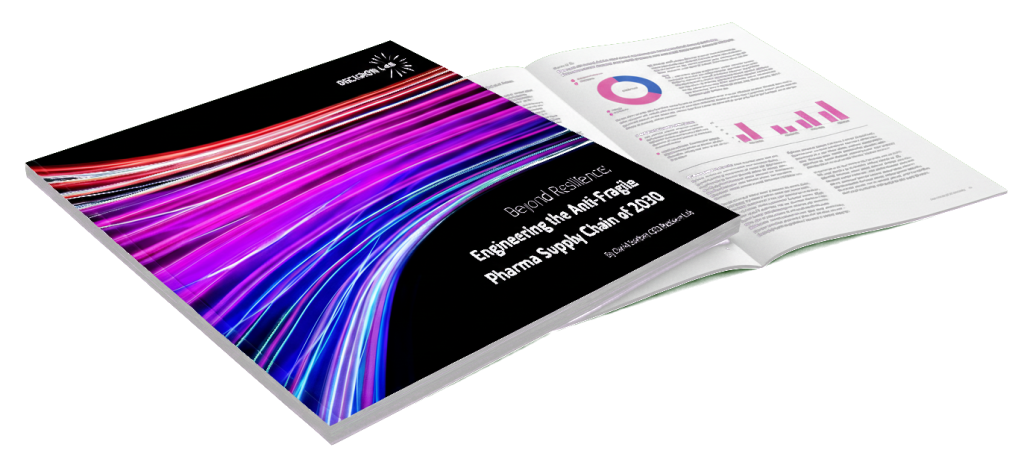
Our Antifragility C-Suite Roadmap for supply chain from Decision Lab CEO David Buxton. Get your copy
Leave a Reply